New Bin outside Goodyear as Student Interest in Composting Grows
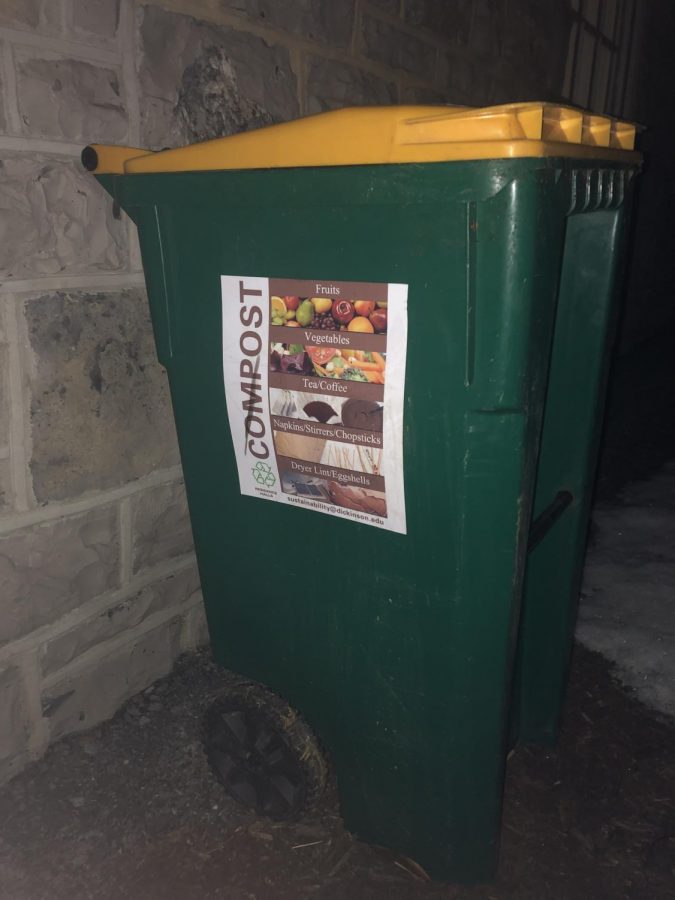
A new compost collection bin will be installed near Goodyear Hall by Thursday, after a student senator proposed the idea to the Center for Sustainability Education (CSE).
Senior Class Senator Amy Halstead and Student Senate Director of Campus Life and Initiatives Mary Hinton ’19 brought the idea to CSE’s assistant director Lindsey Lyons and the Dickinson College Farm director on Feb. 6.
“Point heard,” said Lyons, “[Halstead] and [Hinton] said [the bins] are not super convenient for upper-class students who are in apartment-style living who want to compost more.”
“If they want to compost more, we told them we’d try it,” said Lyons.
Lyons oversees the nearly fifty compost bins available for student use in two or five-gallon sizes. Students can empty their personal bins into any of the four large compost collection bins on campus near Davidson-Wilson Hall, Social Justice special interest housing, Drayer Hall and now Goodyear Hall.
Lyons said student interest in composting has “grown gradually” since it started on campus around 2008. “It has gotten more visible,” she said. “We’ve certainly made less messes and upset less people with dirty piles of food in different places.”
Personal composting is voluntary for students, though CSE’s Eco-Reps often take care of compost bins in their residence halls. “This program has nothing to do with housekeeping,” said Lyons, one reason why she is not keen to push having a compost bin in every apartment.
“We don’t want to hand these things out like candy, because… it’s kind of a gross job. Every semester students adopt bins and they get gross, or full, and housekeeping writes to me,” said Lyons. Still, “over 90 percent of bins are returned clean and on-time,” she said.
“I think that not that many students compost on campus, and part of that is due to accessibility and awareness of our composting system,” said Halstead, who has a compost bin herself. “If just giving them a little bit more information is the push they need to take a little bit of the initiative on their own, then it’s worth it.”
For Goodyear Hall, “really the idea was that the students that were going to be cooking more were the students that were on apartment meal plans, because the idea is that they’re not paying as much so they can buy groceries to use in their real kitchens,” said Halstead.
Sara Cochran ’19 lives in Goodyear Hall and said a compost collection bin near the building “would be so great. It would make life really easy. And I think that it would encourage other people to compost if it was easier to access a compost bin.”
Isabel Gourley ’19 was equally relieved. “Please!” she wrote in a response to the prospect of a Goodyear compost collection bin, “I’m on [R]eed [S]t but I have to walk to the lower quads for my compost and it’s a haul.”
Farm workers pick up the compost weekly from the collection bins and mix them with the compost from the Dining Hall, which is “capturing nearly 100 percent” of waste, said Lyons.
There’s room for improvement, she said, because the waste amount has stayed constant in the Dining Hall for at least six years. It ends up on the farm and turned into certified organic soil, but “more importantly, let’s waste less food,” said Lyons.
Halstead said that seemed to be the motivation for some students she talked with who “just felt bad throwing away so much food waste.”
One extra collection bin sits in CSE’s basement, said Lyons. Some students and Halstead said they were interested in seeing a bin near the school’s Factory Apartments. “I think it really just depends on if having more access to composting bins makes more students interested in composting,” said Halstead.
“For the most part, we do know we’re capturing a lot of waste,” Lyons said of the composting program. “Most students are really into it.”