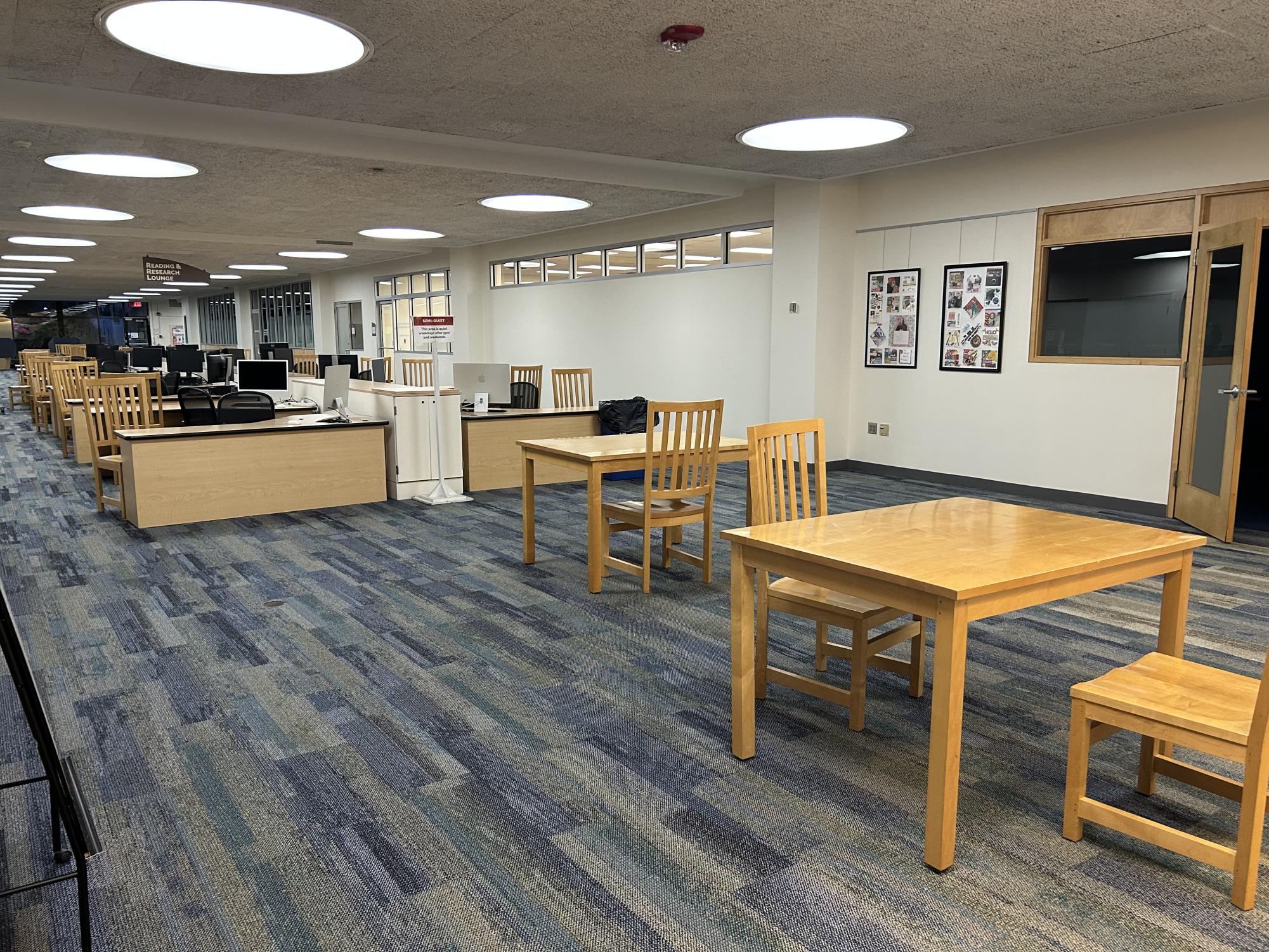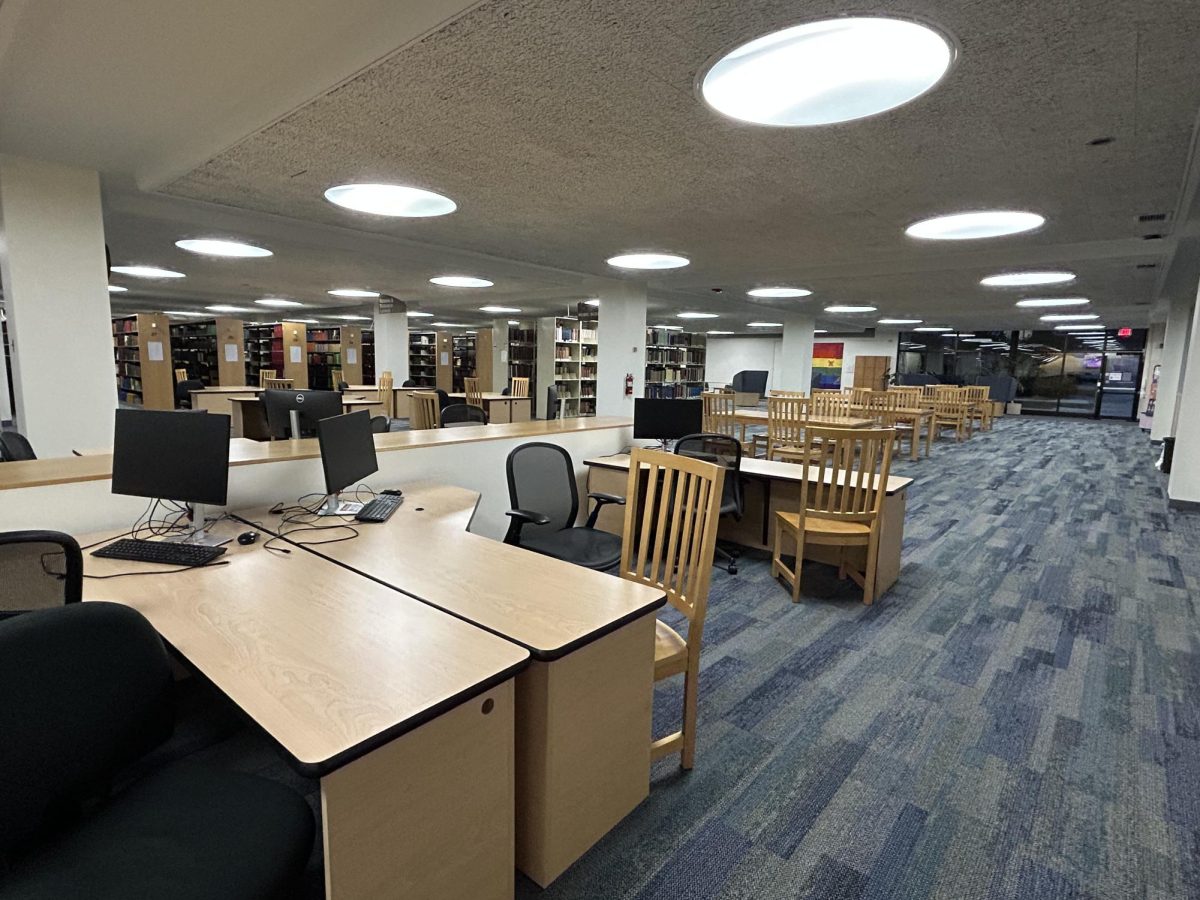
From July to January of last year, multiple campus departments worked together to renovate and restore the lower level of the Waidner-Spahr library, which was damaged by flood during the July 1 storm, and reopened this spring semester. 18,000 square feet of floor, shelves, seating, and other furniture were ruined.
At the lower level’s grand reopening on January 22, Provost Renée Cramer described the flooding as “a sad, stressful, horrible thing.”
Michael Kiner, Facilities Management’s Director of Trades reached out to Advanced Disaster Recovery, Inc. (ADRI), with whom the College has a long working relationship, to assist in cleanup, material handling, and reconstruction.
ADRI quickly installed dehumidifiers and worked on sucking the water back out of the space.
“After the initial water cleanup, material handling was a huge lift,” said Kiner. ADRI moved more than 10,000 boxes of undamaged periodicals, microfilm and microfiche to offsite storage. ADRI tore out the drywall, laid new flooring and re-laid out the furniture at the end of the process.
ADRI also removed the original asbestos floor tile of the lower level, first installed in the late 1960s, according to Kiner. “It was in fine condition, but because the carpet over had been glued to the tile, it would pull up with the carpet.”
Though the basement entrance on Britton Plaza was not available, the two projects did not largely interfere with one another. Elsa Boyer, Operations Manager at ADRI, commented that the lack of accessibility to the Britton Plaza entrance made the asbestos removal a bit more difficult because of the airflow, but that the bigger obstacle was when the elevator broke down during the summer and the materials had to be carried up the stairs.
Over the course of the fall semester, the library was unable to loan out its scores and periodicals to individuals at Dickinson and at other libraries.
Before moving the materials back into the space, the library removed some of them from the collection, particularly periodicals with electronic duplicates, that could be used for more useful materials.
Maureen O’Brien Dermott, the library’s Associate Dean for Access Building Services, described the renovation as a chance to reconsider how students use the lower level space, and what would be best for their needs.
300 students gave feedback on how to redesign the space, which is now the Research and Reading lounge instead of the less-welcoming Information Commons. Design Technician Lisa O’Brien and Dermott considered how students read and worked in each area. O’Brien considered how to make the space cohesive with the rest of the library. She prioritized adding more light and improving the color palette of the space, which now has a warm blue carpet to match that on the first floor. They decided to add more spacing between the stacks to improve the area’s ambiance and sense of openness.
Cramer praised the space’s new aim of “reinvigorating community, democracy and our way of being together.”
Kiner described Library and ITS staff as “great and accommodating,” and representatives of all departments described each other positively.
Several departments stationed in the basement had to move elsewhere on campus until they returned in January.
Michele Kozimor began her position as Director of the Center for Teaching, Learning, and Scholarship the day after the flood. She spent the summer and fall semester working from the conference room on the library’s second floor.
User Services employees moved to the Writing Center over the summer and to the Academic Technology space in Bosler Hall last semester during the renovations, since their offices had flooded, according to Andrew Connell, Director of User Services. Connell and several colleagues worked in the Technical Services area and study carrells in the library during the renovations.