


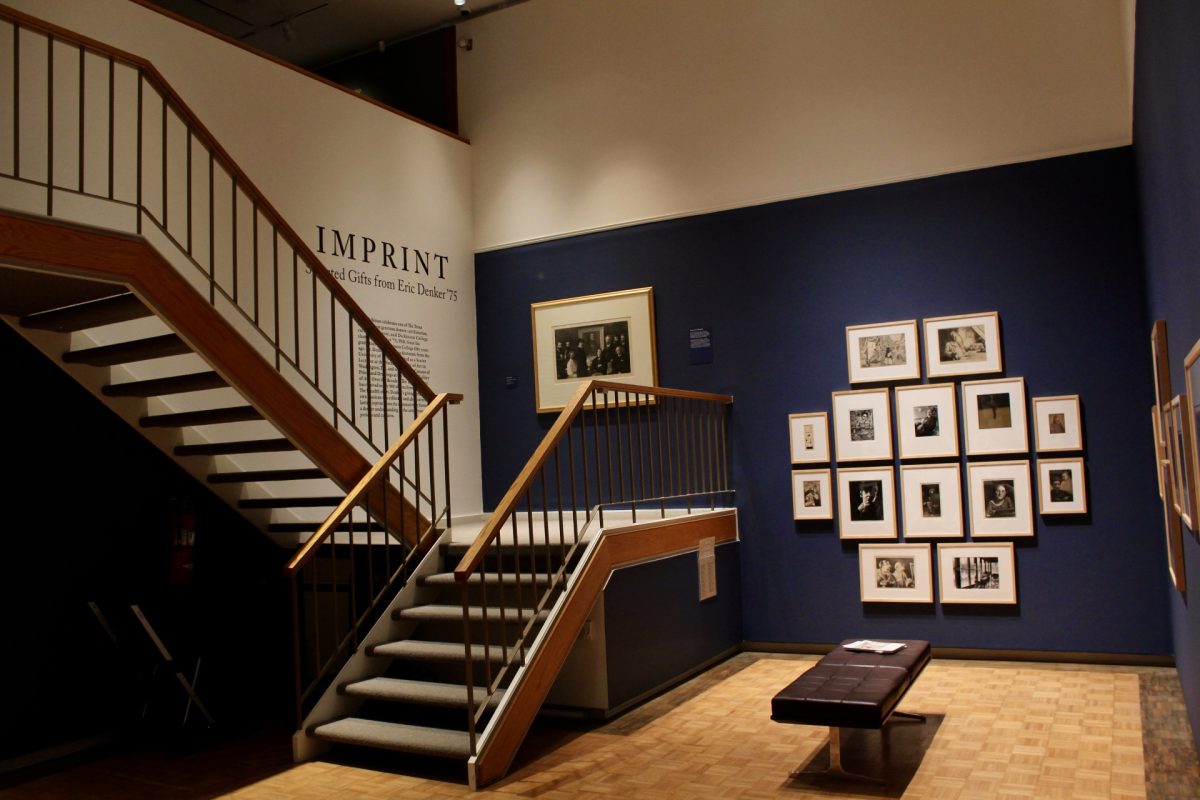
The Trout Gallery held an opening reception for its newest exhibit, titled “Dissecting Locomotion,” on February 20. The exhibition was curated by Art History students Anna Radigan, ‘26, Lena Rimmer, ‘26 and Abigail Allport, ‘26, as a part of their senior thesis under the direction of Art and Art History Professor Elizabeth Lee.
The works featured are primarily by the photographer Edward Muybridge, who worked with the University of Pennsylvania in Philadelphia to study motion through the art of photography. Muybridge worked towards this aim primarily from 1878-1886, producing sets of images showing animals and people in motion, completing actions ranging from running to waving a handkerchief, all in various states of dress. It was his work that uncovered how horses run, as previously, it was thought that they always had at least one hoof on the ground, but Muybridge’s innovations in photography revealed that horses regularly lift all four of their hooves while running. What seems like simple knowledge today took years to Muybridge to prove, and a set of images similar to the ones he made this discovery with is on display in the Trout Gallery.
The way Muybridge photographs motion works similar to how film is made, with each image leading to the next, and so projecting them like film creates a simple animation. That’s exactly what the Trout Gallery does, creating an interesting viewing experience. You can see the still images of Muybridge’s subjects on the wall, and see them in motion. There are also other, older ways to turn still images into motion included in the exhibition. There is a phénakisticope, zoetrope and praxiscope that visitors to the gallery can interact with. These “philosophical toys” were popular at the time Muybridge created his photographs and most people used motion to transform still images into animation.
In addition to being an interesting way to learn about motion and photography, Muybridge’s works raise serious questions that the students who curated this exhibition address. Most of Muybridge’s subjects were white male student athletes from the University of Pennsylvania. However, he also included women from the surrounding community, and patients from the University of Pennsylvania Hospital. These patients, all either disabled or suffering from degenerative diseases, had their gaits recorded by Muybridge as deviations from the white, male and able-bodied models. The issues of gender, race and disability are all discussed by the curators in essays included in the Trout Gallery’s publication for the exhibition. Their work adds complexity and considerations that enrich the works they have chosen to exhibit, and no visit to the gallery would be complete without at least looking through their publication.
Also included in a smaller section of the gallery is work by past Dickinson student and professor, Charles Francis Himes, from the class of 1855. As a contemporary of Muybridge, he would have been familiar with the photographer’s work as he was doing it. Himes’ photographs depict Dickinson students, many of them young women, doing scientific work, showing just how long the tradition of education has been carried on here at Dickinson. It’s also interesting to see our predecessors doing similar work to what we as students do today.
The exhibition will be available for visitors to see until April 4. Stop by before then to see Muybridge’s, Himes’, Radigan’s, Rimmer’s and Allport’s work.
